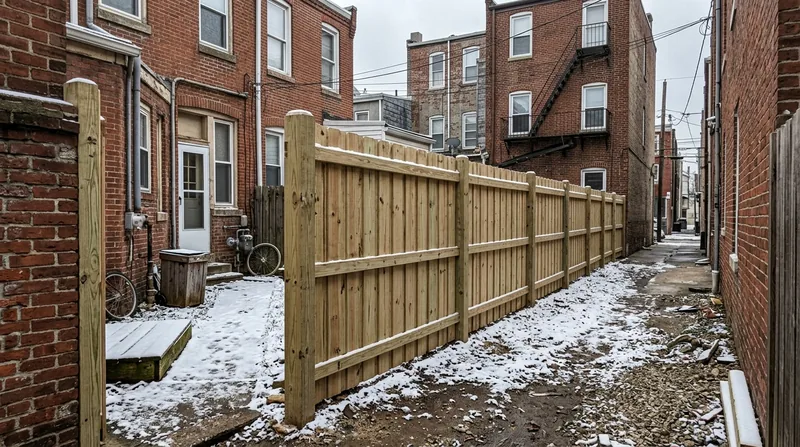




Privacy fence installation in Philadelphia means building a barrier that stands up to the freeze-thaw cycle, the rowhouse lot constraints, and the dense neighborhood context that defines most of our work. Philadelphia homeowners face a specific challenge: shallow frost lines in older neighborhoods, narrow side yards squeezed between twins and rowhouses, and existing masonry that complicates post placement. A properly installed wood privacy fence set below the frost line will stay square through winter heave, shed the heavy wet snow that nor'easters bring, and give you the property line definition and visual privacy that a chain link or ornamental fence cannot. We have been building board-on-board and side-by-side privacy runs since 2010, setting posts in concrete below grade so they hold, and we work from your survey to install on the line you identify.
Why Wood & Privacy Fence Installation Matters in Philadelphia Neighborhoods
The typical Philadelphia lot is tight. A rowhouse in West Philadelphia, a twin in Conshohocken, a post-war block in Lansdowne, a semi-detached in Wynnewood, or a single-family home in Media all share the same practical reality: your fence line runs right along a neighbor's property, often on a boundary that predates any modern survey. Alley access is narrow or nonexistent, side yards are cramped, and existing masonry walls, drains, and utility runs constrain where you can set posts. A board-on-board fence handles this better than any other material because it sheds water, it does not trap snow load the way solid vinyl does, and it can be racked (stepped) or run level depending on the grade. The real differentiator is post depth. Philadelphia sits in a climate where the ground freezes to 40 inches or more below the surface in a hard winter. Posts set shallow will heave upward each spring as ice lenses expand in the soil, and by year three or four they are leaning. Posts set below the frost line in concrete stay put.
- Shallow post holes are the leading cause of fence failure in Philadelphia, and frost heave is the mechanism.
- Board-on-board construction sheds nor'easter snow and heavy rain better than solid vinyl or single-board runs.
- Pressure-treated pine and cedar both hold up in our climate when posts are set deep and the fence is maintained.
- Philadelphia homeowners in HOA communities or deed-restricted neighborhoods must verify height, material, and color rules before installation begins.
- A 6 foot privacy fence is the most common request, but local code sets the actual maximum, and that varies by neighborhood.
Getting the fundamentals right on day one saves money and frustration over the life of the fence.
Key info: Philadelphia's freeze-thaw cycle is the primary design constraint. We set posts 48 inches deep in concrete, below the local frost line, so your fence stays square through winter. In Media, Ardmore, and other suburbs with older lots, masonry walls and narrow side yards are the second constraint, and we route around them without compromising the fence line.
For more information on regulations and permit requirements, see the City of Philadelphia Department of Licenses and Inspections website.
How We Install Wood & Privacy Fencing in Philadelphia: Process and Best Practices
Our installation process is built around the constraints of Philadelphia property lines and climate. We start by confirming the fence line from your survey and locating utilities via a Pennsylvania 811 call. Posts are set in concrete to the frost line depth, spaced 6 feet apart for maximum panel strength and minimal racking. We use pressure-treated pine or cedar for the frame, depending on your budget and aesthetic preference, and we build either board-on-board (alternating boards on each side, so the fence is solid from all angles) or side-by-side (boards on one side only, which is less expensive and still provides privacy). All hardware is galvanized or stainless steel to resist corrosion, and the top rails are capped to shed water and slow rot at the joint. If your lot slopes, we step the fence rather than rack it, which is the cleaner look and the more durable approach.
- We call 811 before digging any post holes to locate underground utilities and avoid damage or injury.
- Posts are dug to below the frost line, set in concrete, and tamped to ensure they are plumb and stable.
- Stringers (horizontal rails) are installed first, then pickets are nailed or screwed to the stringers with staggered fasteners to minimize splitting.
- Board-on-board construction is staggered so that boards overlap slightly, creating a solid visual barrier and better water shedding than single-layer boards.
- We inspect the fence for level, plumb, and nail-pop as we go, and we make adjustments before moving to the next section.
- Final touches include capping the posts, painting or staining if requested, and cleanup of all debris and offcuts.
The entire process, from survey confirmation to final inspection, ensures that your fence is built to last through decades of Philadelphia winters.
Example: A 150-linear-foot board-on-board fence in Drexel Hill with posts set 48 inches deep in concrete, 6-foot spacing, pressure-treated pine frame, and cedar pickets takes 4-5 working days from start to finish, including utility locating, post setting, frame installation, and picket attachment. If the grade is uneven, we step the fence at natural breaks rather than racking it, which adds a day but yields a cleaner result.
For details on other fence types and materials, see our vinyl and PVC fence installation and chain link fence installation pages.
| Approach | Description | Best for |
|---|---|---|
| Board-on-Board | Alternating boards on each side of the stringers, overlapped so the fence is solid from every angle. Pressure-treated pine or cedar frame, cedar or treated pickets. | Maximum privacy and aesthetic appeal. Sheds water and snow load better than single-board designs. Most popular in Philadelphia neighborhoods. |
| Side-by-Side | Boards installed on one side of the stringers only. More economical than board-on-board. Still provides good privacy and visual barrier. | Budget-conscious homeowners who want privacy without the premium cost. Works well for interior lot lines where both sides need not be finished. |
| Stepped Installation | Fence height and panel height adjust at natural grade breaks so the fence stays level across uneven terrain. Requires extra framing and labor but yields a professional appearance. | Sloped lots common in Media, Bryn Mawr, and other suburban Philadelphia properties. Cleaner look than racked (tilted) panels. |
| Racked Installation | Entire panels tilt to follow the slope of the land. Faster and cheaper than stepped, but the fence appears to lean and water can pool at the low side. | Steep grades where stepping is impractical, or when budget is the primary concern. Not recommended for Philadelphia's wet winters unless drainage is excellent. |
Wood & Privacy Fence Installation Cost in Philadelphia: What to Expect
Wood and privacy fence installation in Philadelphia starts at around $34 per linear foot for a basic pressure-treated pine side-by-side fence with posts set in concrete. That figure covers the materials, labor, and post-setting to frost line depth. A board-on-board fence with cedar pickets and a pressure-treated frame runs higher, typically $45 to $65 per linear foot, because cedar costs more than treated pine and the labor to install overlapping boards is more involved. The final price depends on several concrete factors: the length of the run, the terrain (level ground is faster than stepped installation), the species you choose (pressure-treated pine is the most economical; cedar is more durable and attractive but costs more), whether you want a cap and trim on the posts, and whether the fence is accessible by vehicle or must be built by hand in an alley or narrow side yard. A 150-linear-foot fence in Lansdowne with a pressure-treated frame and cedar pickets, board-on-board, with posts set 48 inches deep and stepped to follow the grade, will cost between $7,500 and $10,000 depending on the exact terrain and access. Getting 2 or 3 estimates is always smart, because every lot is different and every contractor has a different overhead and crew efficiency. For a detailed pricing breakdown and to discuss your specific project, see our pricing page or request a free estimate.
Wood & Privacy Fence Installation Near Me: What Philadelphia Homeowners Should Know When Hiring
Hiring a fence contractor in Philadelphia means verifying that they understand the local frost line, the permitting landscape (which varies by municipality), and the HOA or deed restrictions that may govern your fence. Start by asking whether the contractor is fully insured and whether they have experience setting posts below the frost line in your specific neighborhood. Ask for references from recent jobs in your area, and call those homeowners to ask whether the fence has stayed plumb and square through at least one winter season. If your property is in a master-planned community or HOA, confirm that the contractor will verify the architectural guidelines before beginning work, and ask them to put the HOA approval process in writing. Request a detailed estimate that breaks down the cost of materials, labor, post-setting, and any site-specific work like stepped installation or masonry routing. Clarify whether the estimate includes the Pennsylvania 811 utility locate call, because that is required by law and should never be skipped. Finally, ask about the warranty on workmanship and materials, and make sure the contract specifies the fence line, the materials, the construction method (board-on-board or side-by-side), and the timeline. A contractor who takes time to understand your lot, your budget, and your expectations before quoting a price is the one most likely to deliver a fence that lasts. For a consultation with our crew, call (267) 214-2199 or request a free estimate online.
Wood & Privacy Fence Installation in Philadelphia: Pricing Guide
| Service | Price | Details |
|---|---|---|
| Pressure-treated pine, side-by-side | Starting at $34/ft | Posts set in concrete to frost line, 6-foot spacing, pressure-treated frame and pickets, no cap. Most economical option. |
| Pressure-treated frame with cedar pickets, board-on-board | Starting at $48/ft | Board-on-board construction with cedar pickets, pressure-treated stringers, posts set deep, galvanized hardware. Premium privacy and durability. |
| Stepped installation on sloped ground | Add $8-12/ft | Fence height and panel height adjust at grade breaks instead of tilting. Common in Media, Bryn Mawr, and other hilly suburbs. Extra framing and labor. |
| Post cap and trim, galvanized or stainless hardware | Add $3-5/ft | Finished post caps shed water and slow rot. Stainless fasteners resist corrosion better in wet Philadelphia winters. Extends fence life. |
| Estimate | Free | Response within 24 hours at (267) 214-2199. Includes site walk, survey confirmation, and detailed written quote. No obligation to book. |
Indicative pricing, the exact cost depends on square footage, finish, and site access. Free personalized estimate within 24h at (267) 214-2199.


